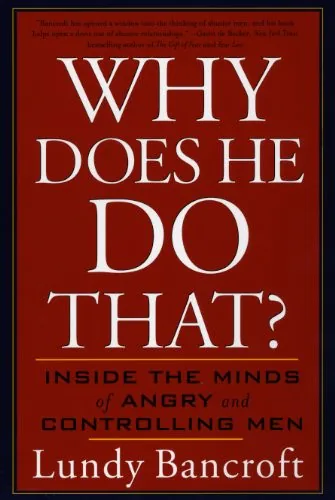
Book Summary: Why Does He Do That? Inside the Minds of Angry and Controlling Men by Lundy Bancroft
As an Amazon Associate I earn from qualifying purchases.
If you are afraid of your partner or in danger, call the National Domestic Violence Hotline at 1-800-799-7233, text START to 88788, or chat at thehotline.org. It is free and confidential. If you are in immediate danger, call 911.
If you’re reading this, you may be trying to make sense of a relationship that leaves you confused, anxious, or afraid. Maybe your partner is charming in public and different at home. Maybe you keep wondering whether you are the problem. Lundy Bancroft spent years running programs for abusive men, and Why Does He Do That? (2002) is what he learned about how they think.
The book is written about men who abuse women, because that was Bancroft’s work. Abuse happens in every kind of relationship, and the hotline helps everyone.
The book: Why Does He Do That? by Lundy Bancroft
On this page
Abuse is a choice, not a loss of control
The most common explanation is that he just loses it: his anger takes over and he can’t help himself. Bancroft says this doesn’t hold up. If your partner were truly out of control, he would explode at his boss, at police officers, and at strangers. Most abusive men don’t. They can rage at home over a cold dinner and then compose themselves the moment someone knocks on the door.
That selectiveness tells you something. His behavior is chosen, even when the feelings behind it are real. Bancroft’s point is that the problem is in how he thinks, not in how strongly he feels. That matters for you, because it means nothing you do or don’t do is what causes it.
Entitlement and control
At the center of the abusive mindset is entitlement. He believes his needs come first, that he gets to make the rules, and that he should be protected from the consequences of his choices. When you see a friend, he hears that he doesn’t matter. When you disagree, he hears disrespect. When you have needs of your own, he calls it selfish.
The goal is control: over what you do, who you see, how you spend money, and even what you think and feel. Tactics include criticism, intimidation, isolation, financial control, and threats. This is why giving in rarely brings lasting peace. Compliance satisfies him for a while, then he finds something new to criticize, because the issue was never the dishes or the friend or the tone of voice.
Bancroft also rejects the idea that abuse is caused by a hard childhood. Many men who grew up in violent homes never abuse anyone. Abusive men learn their attitudes about women and relationships from the people and culture around them, and those attitudes can be unlearned only if he decides to do the work.
The ten types of abusive men
Abusive men don’t all look alike, and many don’t fit the picture of a violent man. Bancroft describes ten styles. Many men mix several.
- The Demand Man. Nothing you do is enough. He expects a lot from you and gives little back.
- Mr. Right. He is always the authority, on politics, on the children, even on your own feelings. He calls it helping you.
- The Water Torturer. Steady, quiet put-downs, sarcasm, and eye-rolling, often in a calm voice, so that you start to look like the one overreacting.
- The Drill Sergeant. He runs the house like a barracks, controls the details of your day, and often isolates you from friends and family.
- Mr. Sensitive. He speaks the language of feelings and self-help, and uses it to make his needs the center of everything and his hurt the reason for his behavior.
- The Player. He is charming and focused on sex, flirts with or sleeps with other women, and treats your hurt as jealousy.
- Rambo. Aggressive and proud of being tough. Intimidation is part of how he deals with the world.
- The Victim. He tells a story in which he is the wronged one, and his abuse becomes a reasonable response to how badly he has been treated.
- The Terrorist. He seems to enjoy frightening you and may make threats against your life. This is the most dangerous type. If this sounds like your partner, please contact the hotline and make a safety plan.
- The Mentally Ill or Addicted Abuser. Mental illness or addiction can make things worse, but they don’t cause abuse and they don’t excuse it. Treating the illness or the addiction doesn’t, on its own, end the abuse.
Early warning signs
Abuse usually starts small and builds. Signs worth taking seriously early on include:
- Criticism that feels constant
- Control over money or other resources
- Pulling you away from friends and family
- Checking up on you or monitoring your phone
- Moods that keep you walking on eggshells
- Threatening or degrading language
- Brushing off your feelings and your point of view
- Disrespect: acting as if his needs matter more than yours
If you recognize several of these, trust what you are noticing. You don’t need to prove anything to anyone before you ask for help.
Why the good times don’t mean he has changed
Bancroft compares the kind stretches to a lab finding called intermittent reinforcement. Mice who are rewarded only sometimes work harder for the reward than mice who are rewarded every time. The same thing happens here. The occasional day when he is loving, kind, or sexy hooks you more tightly than it would if he were steadily good to you.
The bad periods do something else. They make the good periods look bigger than they are. He can seem like two people, and the cruel stretches make the charming one feel extraordinary. He isn’t that extraordinary on the good days. It feels that way because you are coming off the harm. Over time, the lift from those kind periods fades faster. Trying harder to keep him happy doesn’t work, because the abuse was never about your behavior.
What it does to children
Children are harmed by living with abuse even when they are never hit. They learn that relationships run on fear and control. Abusive men also use children to keep control: threatening custody, pressuring children to take sides, or using them to report on their mother. Many parents find that seeing the effect on their children is what helps them act.
Why leaving is so hard
“Why don’t you just leave?” misunderstands the situation. People stay because they love their partner and hope he will change, because they have been isolated, because they have no money or nowhere to go, because they fear losing their children, and because they have been told for years that the problems are their fault.
Leaving can also be the most dangerous time. Research on intimate partner homicide finds that separating from a highly controlling partner raises the risk (Campbell and colleagues, 2003). That is why advocates recommend a safety plan before you leave, and why the hotline is a good first call even if you are not sure what you want to do.
Many people leave and go back more than once before they leave for good. That isn’t weakness. It is a reasonable response to a hard and dangerous situation.
Can he change?
Bancroft doesn’t offer false hope. Some abusive men change, but it is rare, and it takes years of work on the abuse itself, not on his anger, his drinking, or his childhood. A typical program for abusive men runs about twenty-six weeks. He says that is a short time to undo decades of training, and that the question is not whether the program works. It is whether he works the program: showing up, paying for it, and doing the work between meetings for years. Signs of real change look like this:
- He calls his behavior abuse, without blaming you or the circumstances.
- He stops making excuses and accepts the consequences.
- He changes how he treats you over a long period, not just for a few good weeks.
- He respects your decisions, including your decision to leave.
Warning signs that he isn’t changing: he says he has changed but wants credit for it, he uses therapy language against you, he pressures you to get back together quickly, or the abuse goes underground into subtler forms.
Couples counseling and anger management
Bancroft is clear that couples counseling is the wrong tool when one partner is abusing the other. Shared therapy is for shared problems. Control and abuse are the responsibility of the person doing them. If you try to work on it together, he keeps blaming his behavior on you. Bancroft says he has never seen couples counseling produce lasting change in a selfish or abusive partner. Anger management misses the point too. The problem isn’t that he is angry. It is that he is abusive. If he learns to lower the anger, the abuse often just gets calmer. What has a chance of working is a program for abusive men that he takes on himself, for years, plus separate support for you and a safety plan.
If you want to think through what is happening in your relationship, I offer individual sessions, in person in Roseville or by video.
Getting free and staying free
Getting free usually takes both practical planning and emotional support: a safety plan, money of your own, legal help if you need it, and people who will stand by you. Bancroft emphasizes building a life where you don’t depend on the abuser and where you trust your own judgment again.
Afterward, many people grieve the person they hoped he would be, and feel guilty for breaking up the family. Some feel pulled back even when they know the relationship was abusive. These reactions are common, and they ease with time and support.
Related reading:
- What does emotional abuse look like?
- Why do we fall in love with abusive partners?
- Break free from emotional manipulation
- The Body Keeps the Score, on how trauma lives in the body and how people recover
- Codependency, on caretaking and getting your own life back
Sources
- Bancroft, L. (2002). Why Does He Do That? Inside the Minds of Angry and Controlling Men. Berkley Books.
- Bancroft, L. (2015). Daily Wisdom for Why Does He Do That? Berkley Books. The notes on good periods, anger management, couples counseling, and how long change takes follow this book.
- Campbell, J. C., Webster, D., Koziol-McLain, J., et al. (2003). Risk factors for femicide in abusive relationships: Results from a multisite case control study. American Journal of Public Health, 93(7), 1089-1097. doi.org/10.2105/AJPH.93.7.1089
Related video
Bancroft’s point is that this behavior is chosen control. This video walks through a couple where the husband keeps pressing his wife for comfort he admits will not help, and he decides when the conversation gets to be about her.
You can talk this through with me on your own. If you are afraid of your partner, call the National Domestic Violence Hotline at 1-800-799-7233 first.