Book Summary: The Body Keeps the Score by Bessel van der Kolk
As an Amazon Associate I earn from qualifying purchases.
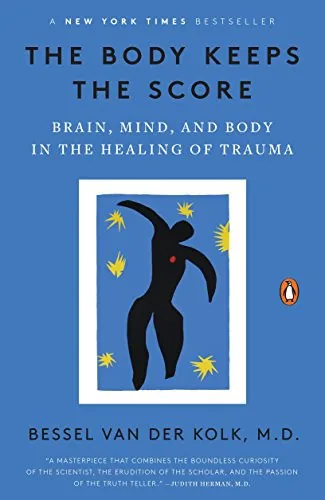
The book: The Body Keeps the Score by Bessel van der Kolk
The Body Keeps the Score (2014) is by Bessel van der Kolk, a psychiatrist who has studied and treated trauma since the 1970s. His argument is in the title: trauma is not only a memory. It changes how the brain and body work, so people can know they are safe and still feel in danger. The book is long and fairly technical. This summary follows its five parts.
Part One: The Rediscovery of Trauma
Lessons from Vietnam Veterans
Van der Kolk began his career at a Veterans Administration clinic in 1978. The veterans he met had flashbacks, nightmares, rage, and a numbness that cut them off from their families. Talking about the war didn’t make it go away. Their bodies kept reacting as if the danger were still happening. Post-traumatic stress disorder became an official diagnosis only in 1980.
Revolutions in Understanding Mind and Brain
He describes the experiments on learned helplessness, in which animals exposed to shocks they couldn’t escape stopped trying to escape even when the door was open. Traumatized people often show the same collapse. He also traces the rise of psychiatric medication. Drugs can take the edge off symptoms, but they don’t resolve what the trauma did.
Looking into the Brain: The Neuroscience Revolution
Brain scans of people reliving a trauma showed the brain’s main speech area going quiet, while areas tied to emotion and the senses lit up. That is why trauma can feel “unspeakable”: in the moment, the parts of the brain needed to put it into words are offline.
Part Two: This Is Your Brain on Trauma
Running for Your Life: The Anatomy of Survival
The brain is built from the bottom up: a survival brain that runs the body, an emotional brain that scans for danger, and a thinking brain on top. Van der Kolk calls the amygdala the brain’s smoke detector and the part of the prefrontal cortex that judges whether the alarm is real the watchtower. After trauma the smoke detector goes off too easily and the watchtower can’t calm it, so a raised voice or a certain smell can set off a full alarm.
Body-Brain Connections
Emotions live in the body. Van der Kolk draws on Stephen Porges’s polyvagal theory, which describes three levels of response: connecting with other people, fighting or fleeing, and finally shutting down. Polyvagal theory is popular with therapists, though some researchers dispute parts of it. The practical point holds either way: feeling safe with other people is what calms the body.
Losing Your Body, Losing Your Self
Many traumatized people stop feeling their bodies at all. They can’t tell what they feel or need, a problem called alexithymia, and some feel unreal or detached from themselves. Recovery means learning to notice body sensations again.
Part Three: The Minds of Children
Getting on the Same Wavelength: Attachment and Attunement
Children learn to manage their feelings through attuned caregivers who notice and respond to them. Van der Kolk draws on attachment research by John Bowlby, Mary Ainsworth, and Edward Tronick, whose still-face experiment showed how quickly babies fall apart when a parent stops responding.
Trapped in Relationships: The Cost of Abuse and Neglect
Children who are abused or neglected adapt in ways that help them survive and hurt them later: staying watchful, keeping people at a distance, or clinging. As adults they may be drawn to familiar kinds of danger.
What’s Love Got to Do with It?
The Adverse Childhood Experiences study, which surveyed about 17,000 Kaiser Permanente patients, found that childhood abuse, neglect, and household dysfunction were common and strongly linked to later physical and mental illness.
Developmental Trauma: The Hidden Epidemic
Van der Kolk and colleagues proposed a diagnosis for children traumatized by their caregivers, called developmental trauma disorder. It was not added to the DSM-5, which he sees as a missed chance to treat these children for what is actually wrong.
Part Four: The Imprint of Trauma
Uncovering Secrets: The Problem of Traumatic Memory
Ordinary memories become stories that change over time. Traumatic memories are stored as fragments: images, sounds, sensations, and feelings, without a clear beginning, middle, and end. When something triggers them, they feel like the present, not the past.
The Unbearable Heaviness of Remembering
He reviews the long history of traumatic memory, from 19th-century doctors studying what was then called hysteria to the arguments of the 1990s over repressed and recovered memories.
Part Five: Paths to Recovery
Healing from Trauma: Owning Your Self
Recovery starts with calming the body and becoming able to notice what is happening inside you: breathing, mindfulness, rhythm, touch, and safe relationships. Van der Kolk describes it as working from the bottom up as well as from the top down.
Language: Miracle and Tyranny
Putting experience into words helps, including writing about it privately, which James Pennebaker’s research found improves health. But words alone are often not enough, because so much of trauma lives below language.
Letting Go of the Past: EMDR
In EMDR, a person holds a traumatic memory in mind while following side-to-side eye movements or other back-and-forth stimulation. In van der Kolk’s own study, EMDR did better than the antidepressant Prozac, and worked especially well for people whose trauma happened in adulthood. After treatment, the memory is still there, but it feels like the past.
Learning to Inhabit Your Body: Yoga
Trauma-sensitive yoga helped people in his studies feel their bodies again and tolerate sensations, and it improved symptoms of chronic PTSD.
Putting the Pieces Together: Self-Leadership
Internal Family Systems therapy, developed by Richard Schwartz, sees the mind as a family of parts, some protecting and some carrying old pain, with a calm Self that can lead them. Treating your reactions as parts trying to protect you makes them easier to work with.
Filling in the Holes: Creating Structures
Pesso Boyden System Psychomotor therapy uses group role-play to let people experience, symbolically, the caring responses they needed as children and never got.
Rewiring the Brain: Neurofeedback
Neurofeedback shows people their brain-wave activity in real time so they can learn to shift it. Van der Kolk reports good results for people with severe developmental trauma.
Finding Your Voice: Communal Rhythms and Theater
Singing, dancing, and theater put people back in sync with others. He describes theater programs in which traumatized teenagers and veterans learn to feel and express emotions safely by playing them on stage.
What this means for your relationship
When a partner overreacts to something small, trauma is often part of the explanation. The smoke detector is going off, and the thinking brain isn’t available in that moment. That doesn’t make the reaction acceptable, but it does change the question from “why are you like this?” to “what is your body reacting to?”
It also means a close relationship can help calm an alarmed nervous system, or keep it on edge. Couples who learn to recognize when one of them is flooded, slow down, and come back to the conversation later do better than couples who push through.
Related reading:
- Hold Me Tight, on reconnecting after hurt
- Trauma: a conversation with Catherine Roebuck
50-minute sessions cost $300
Your first session is free
I don’t take insurance