Book Summary: Come As You Are by Emily Nagoski
As an Amazon Associate I earn from qualifying purchases.
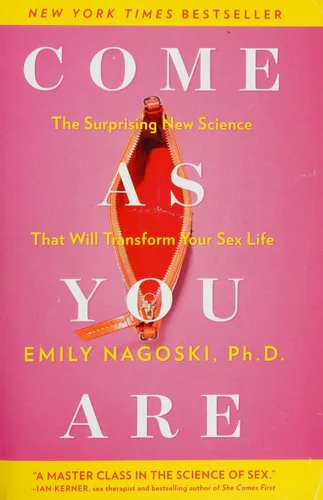
The book: Come As You Are by Emily Nagoski
Come As You Are (2015) is by Emily Nagoski, a sex educator with a PhD in health behavior. It is written mainly for women, and it is useful for anyone with a partner who is a woman. Her central message is that you are normal: everyone’s sexuality is made of the same parts, organized in different ways. This summary follows the 2015 edition: four parts and nine chapters.
If desire has become a source of conflict in your relationship, book a free first session.
Part One: The (Not-So-Basic) Basics
Chapter 1: Anatomy: No Two Alike
Nagoski starts with the body. Male and female genitals develop from the same tissue in the womb, so they are made of the same parts organized differently. Bodies vary enormously, and that variation is normal. A lot of sexual worry starts with the belief that something about your body is wrong.
Chapter 2: The Dual Control Model: Your Sexual Personality
The core of the book is the dual control model, developed by researchers John Bancroft and Erick Janssen at the Kinsey Institute. Your brain has a sexual accelerator, which responds to sexually relevant things you see, hear, feel, or imagine, and sexual brakes, which respond to reasons not to be turned on: stress, worry about your body, fear of pregnancy, a messy kitchen, an argument from that morning.
Everyone’s accelerator and brakes are set at different sensitivities, and the book includes a questionnaire to find yours. Nagoski’s key point is that most sexual difficulties come from brakes that are being pressed, not from an accelerator that isn’t working. Turning off the brakes usually does more than pressing harder on the accelerator.
Chapter 3: Context
The same stimulus can produce very different reactions depending on context. Nagoski describes research by neuroscientist Kent Berridge, in which stimulating the same area of a rat’s brain produced eager approach in a comfortable environment and fearful behavior in a stressful one. People are similar. Your partner’s touch can feel sexy when you are relaxed and annoying when you are overwhelmed.
Part Two: Sex in Context
Chapter 4: Emotional Context
Two emotional systems matter most: stress and love. Stress hits the brakes for most people. Nagoski explains the stress response cycle: your body gears up to deal with a threat, and it needs to finish that cycle, through physical activity, crying, laughing, affection, or rest, before it can relax. Dealing with the stressor isn’t the same as dealing with the stress.
Love and attachment can work in either direction. Feeling safe and connected with your partner eases the brakes for many people, while worry about the relationship presses them.
Chapter 5: Cultural Context
Most people absorb messages that sex is dangerous, shameful, or a performance to be graded, and that their bodies don’t look the way they should. Those messages press the brakes. Nagoski argues that self-criticism about your body is one of the biggest brakes, and that self-compassion and body appreciation help.
Part Three: Sex in Action
Chapter 6: Arousal: Lubrication Is Not Causation
Genital response and feeling turned on are not the same thing. Nagoski cites research finding about a 10 percent overlap between genital response and subjective arousal for women, and about a 50 percent overlap for men. This is called arousal nonconcordance. A body can respond to something sexually relevant without the person wanting it, and a person can want sex while their body is slow to respond. Genital response is not desire, and it is not consent.
Chapter 7: Desire: Actually, It’s Not a Drive
Nagoski’s chapter title is the argument: sexual desire is not a drive, the way hunger is. If it were, the people who rarely want sex out of nowhere would be broken. They aren’t. There are two common styles of desire. Spontaneous desire seems to appear out of the blue. Responsive desire shows up in response to pleasure and closeness, once things have started. Nagoski estimates that about 75% of men and 15% of women experience mostly spontaneous desire, and about 30% of women and 5% of men mostly responsive desire. Many people experience both.
Responsive desire is not low desire. A partner who rarely feels like having sex out of the blue may enjoy it once things get going. Couples with different styles do better when they stop waiting for the responsive partner to want sex first and create the conditions in which desire can show up.
Part Four: Ecstasy for Everybody
Chapter 8: Orgasm: The Fantastic Bonus
Orgasms vary from person to person and from one time to the next. About 30 percent of women orgasm reliably from intercourse. The other 70 percent sometimes, rarely, or never do, and Nagoski treats that as normal. She calls orgasm a fantastic bonus. The way through orgasm trouble, she writes, is to make pleasure the goal, not orgasm. Focusing on orgasm as the target often makes both pleasure and orgasm harder to reach.
Chapter 9: Meta-Emotions
The last chapter is about how you feel about your feelings. Feeling ashamed or frustrated about your sexuality presses the brakes. Feeling curious, kind, and accepting toward yourself eases them. This is where the title comes from: you can come to sex as you are, and work with your sexuality rather than against it.
What this means for your relationship
Many couples treat a difference in desire as a sign that one partner doesn’t love or want the other. Nagoski’s model gives you a better set of questions: What hits your brakes? What eases them? What context makes pleasure possible for you, and for your partner?
It also changes how you talk about sex. “You never want to” becomes “What gets in the way, and what helps?” That conversation tends to go better for both partners.
Related reading:
- Mating in Captivity by Esther Perel, on why desire needs some distance
- Passionate Marriage by David Schnarch, on sex and growing up in marriage
- Differences in sexual desire are good, actually
- Why the lower-desire partner always controls sex
50-minute sessions cost $300
Your first session is free
I don’t take insurance